Tank Deformation Analysis: What It Is & Why It Matters
Storage tanks are subject to constant physical stress. Whether they’re holding crude oil at a refinery, refined petroleum products at a coastal terminal, or liquefied gas in sub-zero conditions, these structures are under continuous pressure – from the weight of their contents, changes in temperature, ground movement, and the passage of time.
Over the years, that stress can leave its mark. Shells buckle. Floors settle unevenly. Structural geometry shifts in ways that aren’t always visible to the naked eye. This is where storage tank deformation analysis becomes essential – one of the most technically rigorous and operationally critical surveys available as part of any storage tank surveying programme.
What Is Storage Tank Deformation Analysis?
Storage tank deformation analysis is a survey methodology used to detect, measure, and map changes in the physical geometry of a storage tank over time. It examines the shell, floor, and overall structural form of the tank to identify any displacement, distortion, or movement from its original, or previously recorded, condition.
In practical terms, a tank deformation survey answers a fundamental question: has this tank moved, and if so, by how much, where, and in which direction?
The data gathered allows engineers, asset managers, and integrity specialists to:
- Quantify outward or inward shell deformation (often referred to as “bulging” or “buckling”)
- Detect uneven floor settlement and foundation movement
- Monitor changes in tank verticality and structural column alignment
- Assess the suitability of a floating roof to continue operating safely
- Identify areas of peaking and banding across the tank shell
Without this level of geometric insight, tank deformation can go undetected – with potentially serious consequences for safety, compliance, and operational continuity.
How Tank Deformation Analysis Has Evolved
Historically, deformation surveys relied on manually placing a series of target points at predefined locations on the tank shell. Surveyors would measure those points and track any movement between surveys. While effective in principle, this approach had inherent limitations; it could only report on the specific locations that had been targeted, meaning deformation between those points could be missed entirely.
Modern storage tank deformation analysis at Storage Tank Surveys is driven by high-accuracy laser scanning technology. Rather than sampling a handful of discrete points, a laser scanner captures the entire surface of the tank in a single data-rich point cloud – often comprising tens of millions of measurement points. This means no part of the shell is left uncharacterised, and even subtle deformation in areas that wouldn’t have been manually targeted can be identified and measured.
The completeness of the dataset doesn’t just improve detection rates, it transforms the quality of the tank deformation analysis altogether.
What Does A Storage Tank Deformation Survey Involve?
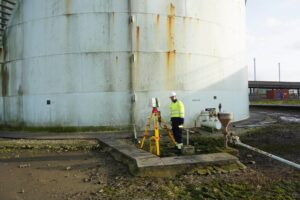
A typical tank deformation survey using laser scanning follows a structured process:
- Mobilisation and site setup – surveyors attend the site with high-precision laser scanning equipment and, where required, UAV (drone) technology for areas that are difficult to access safely at height or in confined locations
- Data capture – the scanner captures a full 360° point cloud of the tank shell, floor, and associated structure
- Data processing – the raw point cloud is processed and registered into a complete geometric model of the tank
- Deformation mapping – the processed data is compared against a reference geometry (either design data or a previous survey) to produce a full deformation map
- Reporting – results are presented in a format tailored to your requirements
At Storage Tank Surveys, we deliver tank deformation data in multiple reporting formats, including:
- Excel radial displacement graphs – showing deformation at specific heights around the tank circumference
- Cross sections in AutoCAD – enabling detailed engineering review of shell geometry
- Colour-coded deformation image maps – providing an immediate visual overview of the entire tank surface, with red indicating outward displacement and blue indicating inward displacement
This flexibility ensures that the data is accessible and actionable for everyone, from field engineers to senior asset managers.
Why Does Storage Tank Deformation Analysis Matter?
Safety and Structural Integrity
A storage tank that has deformed beyond acceptable tolerances is operating outside its design parameters. In worst-case scenarios, unchecked shell deformation can compromise the structural integrity of the tank, increasing the risk of catastrophic failure – particularly in tanks storing flammable, corrosive, or hazardous contents.
Regular tank deformation monitoring is a critical part of any responsible asset integrity programme. It allows operators to detect problems early, assess risk accurately, and make evidence-based decisions about maintenance, repair, or decommissioning.
Floating Roof Performance
For tanks with floating roofs, storage tank deformation analysis is especially important. A roof designed to fit a tank with a specific shell geometry will not perform correctly if that geometry has changed significantly. Out-of-round shell conditions can impair the seal between the roof and the shell, leading to vapour loss, fire risk, and non-compliance with environmental regulations.
A tank deformation survey provides the data needed to assess whether the existing floating roof remains fit for purpose and to inform the design of a replacement if required. This links closely with our 3D modelling services, which can produce detailed layout drawings to support floating roof design.
Regulatory Compliance and Inspection Frameworks
In the UK and internationally, storage tanks are subject to a range of inspection and integrity management standards, including API 653 (Tank Inspection, Repair, Alteration, and Reconstruction), API 650, EEMUA 159, and EN14015. These frameworks typically require operators to maintain records of tank condition, including geometric deformation data, as part of a documented risk-based inspection (RBI) programme.
A storage tank deformation survey carried out by qualified surveyors and documented with a clear, auditable report provides exactly the kind of evidence these frameworks require.
Monitoring Change Over Time
A single tank deformation survey captures the condition of an asset at a point in time. Its real value, however, comes from repeat surveys. By comparing results from successive surveys, it becomes possible to track the rate of change, which is often more important than the absolute deformation value at any given moment.
A tank that shows 5mm of deformation with no change over three years presents a very different risk profile from one that has progressed 5mm in six months. It is this trend data that allows asset managers to plan maintenance proactively rather than reactively.
Storage Tank Deformation Analysis vs. Tilt & Subsidence Monitoring
These two storage tank surveying services are related but distinct, and are often commissioned together as part of a comprehensive integrity assessment.
| Survey Type | What It Measures | Key Output | Typical Trigger |
|---|---|---|---|
| Deformation Analysis | Shell geometry, outward/inward distortion, peaking and banding, floor settlement | Deformation maps, radial displacement graphs, and AutoCAD cross sections | Shell buckling, integrity reviews, and floating roof assessment |
| Tilt & Subsidence Monitoring | Overall tank lean, foundation settlement, differential settlement across the base | Settlement profiles, tilt vectors, levelling data | Ground movement concern, soft ground conditions, post-event assessment |
In many cases, the findings from one survey will prompt further investigation using the other. A tank showing foundation settlement identified during tilt and subsidence monitoring may require a full storage tank deformation analysis to understand how that settlement has affected the overall shell geometry.
When Should You Commission A Tank Deformation Survey?
There is no single answer to this – it depends on the age, condition, and service history of the tank, as well as the applicable regulatory framework and the risk profile of its contents. However, a storage tank deformation survey is typically recommended in the following circumstances:
- During planned inspection shutdowns – when the tank is out of service, a laser scan can be carried out efficiently alongside other inspection activities
- Following any significant event – including flooding, ground movement, seismic activity, overfilling, or impact damage
- As part of a new terminal commissioning survey – to establish a baseline geometry against which future surveys can be compared (see our existing and new terminal surveys)
- When a floating roof is due for replacement – to ensure the new roof is designed to match the actual shell geometry, not the original design geometry
- When other inspection findings raise concern – for example, if a tank floor inspection reveals uneven settlement, or if visual inspection identifies visible shell distortion
- On a scheduled periodic basis – as part of a proactive integrity management programme
The frequency of repeat tank deformation surveys will depend on the risk profile of the asset, but many operators working to RBI frameworks carry out deformation surveys every 5-10 years as a minimum.
Comprehensive Storage Tank Surveying Services
At Storage Tank Surveys, we bring decades of expertise in storage tank geometry measurement and structural analysis. Our surveyors are experienced in working across a range of environments, from UK refineries and fuel depots to remote international locations including North Africa and Greenland.
We use high-accuracy laser scanning equipment, supplemented by UAV technology where conventional access is limited. Our reports are tailored to client requirements and produced to professional standards, providing clear, actionable data that supports sound engineering decisions.
To find out more about our full range of storage tank surveying services, or to discuss your specific requirements, contact our team today.