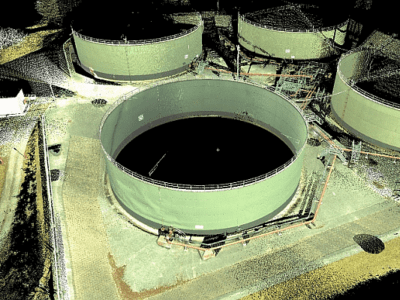
Yes. We use laser scanning to capture the full geometry of the sphere, from which accurate volumetric data can be derived, including any out-of-sphericity. This is typically more accurate than traditional calibration methods on spherical vessels.

Liquefied gas storage, whether propane, butane, LPG mixes, LNG or other cryogenic products, demands a very different approach to survey. Tanks are pressurised, often spherical or bullet-shaped, and subject to strict safety controls that limit traditional survey methods.
Accurate dimensional data is still essential for calibration, deformation monitoring and ongoing integrity work, but it has to be captured in a way that works around the operational realities of a live facility.
At Storage Tank Surveys, we deliver specialist LPG and LNG tank surveys worldwide using laser scanning – a technology particularly well suited to complex geometries and live operational environments.
Our teams specialise across the full range of liquefied gas storage, including:
We deliver the dimensional survey work that underpins accurate operation and ongoing integrity management, including:
Spherical and bullet tanks are much harder to survey accurately with traditional methods. A laser scan captures millions of points across the full tank surface, producing a complete three-dimensional record from which accurate volumes, deformation and any out-of-sphericity can be derived directly.
There are also practical advantages on live LPG and LNG sites. The scan can typically be carried out from outside the primary containment area, reducing exposure of survey personnel to process hazards. UAV capture can reach areas that would otherwise require scaffolding or working at height. And the same scan dataset supports calibration, deformation, 3D modelling and future comparison, so you get more value from each site visit.
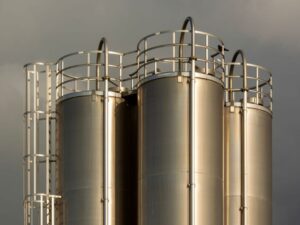

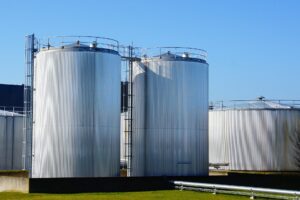
Spherical and bullet tanks are much harder to survey accurately with traditional methods. A laser scan captures millions of points across the full tank surface, producing a complete three-dimensional record from which accurate volumes, deformation and any out-of-sphericity can be derived directly.
There are also practical advantages on live LPG and LNG sites. The scan can typically be carried out from outside the primary containment area, reducing exposure of survey personnel to process hazards. UAV capture can reach areas that would otherwise require scaffolding or working at height. And the same scan dataset supports calibration, deformation, 3D modelling and future comparison, so you get more value from each site visit.
LPG and LNG storage is governed by a demanding set of industry standards and regulatory frameworks, including EEMUA 159, API 653, EN 14620 for LNG containment, and UK frameworks such as COMAH for major hazard sites.
Our dimensional surveys provide the accurate geometric data your engineers and inspection bodies rely on when supporting their integrity and compliance assessments. We are not an inspection authority, and we do not determine tank integrity or certify compliance; our role is to make sure the data behind those assessments is as accurate as it can be.
Our team has delivered specialist surveys in a wide range of climates and operational environments and have worked in over 60 countries. Wherever your storage is located, we can mobilise and deliver.
Yes. We use laser scanning to capture the full geometry of the sphere, from which accurate volumetric data can be derived, including any out-of-sphericity. This is typically more accurate than traditional calibration methods on spherical vessels.
LNG programmes typically include calibration, shell deformation, verticality, settlement and, for outer containment structures, roof and bund geometry. Specific requirements vary by standard and operator; we scope the details with you at the start of the project.
External scanning is the primary method, capturing the outer shell, roof and surrounding structures. The scan produces a complete 3D record that supports calibration, deformation and integrity analysis.
Yes. Laser scanners are passive instruments and don’t introduce any hazard to the tank or its contents. Scans can generally be carried out while the tank remains in service, subject to site access and safety planning.