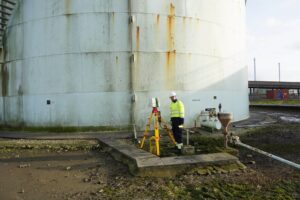
Tank floor inspection is a critical element of storage tank maintenance that protects your assets, ensures regulatory compliance, and prevents catastrophic failures. The floor of a storage tank bears the entire weight of the stored product and is particularly vulnerable to corrosion, settlement, and degradation over time. Regular inspections identify issues such as bottom plate corrosion, foundation problems, and structural weaknesses before they result in environmental contamination, product loss, or costly emergency shutdowns.
For operators across Devon and the South West, our tank floor inspection services provide the detailed assessment needed to maintain safe operations, meet industry standards including API 653 and BS EN 14015, and extend the operational lifespan of your storage infrastructure.
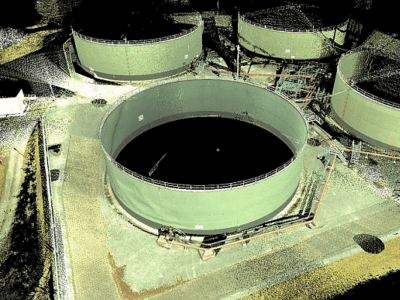
Our comprehensive tank floor inspection methodology combines traditional surveying techniques with advanced technology to deliver accurate, reliable assessments. We begin with a thorough visual inspection of accessible floor areas, identifying obvious signs of corrosion, settlement, or damage. We then use laser scanning to capture the full floor and shell geometry, giving accurate floor levels across the whole tank rather than at a few sample points. Where metal loss needs quantifying, ultrasonic thickness readings at strategic locations measure the remaining floor plate thickness to assess corrosion rates and predict remaining service life.
For larger installations, we employ magnetic flux leakage (MFL) scanning technology that rapidly surveys extensive floor areas, detecting corrosion and pitting beneath coatings and linings.
A tank settlement survey levels the tank floor and the base of the shell, then compares the results against the original construction levels or a previous survey. We look at three types of movement: uniform settlement, where the whole tank sinks evenly; planar tilt, where the tank leans as a rigid body; and differential settlement, where parts of the floor or shell base drop further than others. Differential settlement does the most damage, because it distorts the shell and puts stress on the floor welds and annular ring.
Our settlement data is presented in a form that supports assessment against API 653 Annex B, which sets out how tank bottom and shell settlement should be evaluated. Repeating the survey at intervals shows whether settlement has stopped or is still progressing, which is the key question when deciding whether a tank can stay in service.

Bottom plate corrosion is the most common tank floor issue, caused by water accumulation, aggressive products, or external soil conditions. We identify general corrosion, localised pitting, and preferential corrosion at welds and stress points. Our ultrasonic thickness surveys quantify metal loss and predict when floor replacement will be required.
Uneven foundation settlement creates stress concentrations that can lead to floor buckling, shell distortion, and leak pathways. We identify areas of differential settlement and measure floor deformation that may compromise tank integrity. For detailed analysis of settlement patterns and their implications, our deformation analysis service provides comprehensive 3D modelling of tank geometry changes.
Floor plate welds are potential weak points where corrosion often initiates. We examine weld quality, identify cracking or separation, and assess any corrosion occurring preferentially along weld seams. Critical welds receive particular attention, including annular ring welds that connect the floor to the tank shell.
Where internal coatings or linings are present, we assess their condition and effectiveness. Coating breakdown accelerates corrosion and indicates areas requiring remedial attention. We identify disbonded areas, coating failure, and underlying corrosion beneath protective systems.
Floor condition often reflects underlying foundation problems. We identify signs of soil subsidence, inadequate foundation support, and groundwater ingress. For ongoing monitoring of foundation stability, our tilt and subsidence monitoring service tracks changes over time.